SIIF 2026 at a Glance
- When: 11-13 November 2026
- Where: Central Military Club, Sofia, with two parallel halls
- Theme: "New fronts in information warfare: a European response"
- Focus: Southeast Europe and the Black Sea region
- Programme: the full agenda is on the official SIIF site
What SIIF 2026 Set Out to Answer
This year's edition put Southeast Europe and the Black Sea region in the spotlight, a region the organisers describe as uniquely exposed to foreign information manipulation and interference (FIMI). The programme was built around three questions:
- Will authoritarian powers such as Russia, China and Iran use information manipulation to align parts of the Global South against democratic nations?
- Will propaganda and disinformation deepen internal divisions and erode trust in democratic institutions?
- Which strategies, tools and partnerships can keep the information space resilient?
Sessions ran across five thematic tracks: Policy and Resilience, Comparative Research Perspectives, Technologies Against Disinformation, Media Literacy and Education, and Information Operations and Impact.
Three Days in Two Halls
Day 1: War, Elections and Algorithms
The forum opened on 11 November with the organisers, including our CEO Nesin Veli, followed by a keynote from Sophia Eriksson-Waterschoot, Deputy Director-General for Communication at the European Commission. The first day moved from technology and communication in wartime, with speakers from PR Army and the Atlantic Council's DFRLab, to electoral integrity: researchers from Watchdog.md, the Center for the Study of Democracy, Funky Citizens Romania and NASK Poland discussed how to go from detecting FIMI to disrupting it.
The afternoon asked how platforms shape elections in "TikTokcracy Unmasked", looked at multi-domain hybrid threats on NATO's eastern flank, and closed with sessions on AI, politics and media and on resilience in wartime. In the second hall, Data for Good and GATE Institute showed how large language models and NLP tools can detect harmful narratives in Bulgarian media, and DisInfoHack finalists presented student research.
Day 2: Narratives, Influence and AI Chatbots
The second day turned to the narratives themselves: propaganda risks around Ukraine's EU accession, conspiracy beliefs across Europe, China's "soft power", climate information integrity and propaganda images of Europe in Bulgarian media. A panel on AI and cognitive security brought together Gerulata Technologies, EDHEC Business School and the Institute for Strategic Dialogue, and the Wikimedia Foundation spoke about safeguarding Wikipedia during elections and crises.
A two-part Protocol Lab, run by the Center for the Study of Democracy and Data for Good, worked on a practical method for spotting whether Russian-backed sources and narratives surface in AI chatbot answers in Bulgarian. The day ended with youth and culture sessions and a screening of the documentary "Putin's Playground".
Day 3: Media Literacy and Hands-On OSINT
The final morning looked ahead: the future of media literacy, Europe's next layer of cognitive resilience, and a hands-on OSINT session on following influence networks from Russia to Bulgaria, moderated by AEJ-Bulgaria. A three-part youth workshop ran alongside. The forum closed with a proposal for an information resilience mechanism for Bulgaria's Ministry of Foreign Affairs and government, and reflections on the three days.
Identrics at SIIF 2026
Opening the Forum
Our CEO, Nesin Veli, opened the forum with a challenge to think beyond retrospective analysis and consider where the analyst and technology community can have the most impact. He described information integrity not as a fixed state to achieve, but as something sustained through communication.
"The integrity of information is a balancing act, it is a push and a pull in a narrow corridor. It comes into existence through exercising communication, which is a forward-looking act of expression and connection."
Pointing to the growing role of consumer chatbots and the human sources their answers rely on, he argued: "The creators are the choke point of the attention economy." His closing question to the audience was where their expertise could have the most impact on information integrity.
Asking Chatbots Who to Vote For
On the first afternoon, Devora Kotseva moderated "The Algorithmic Influence Machine: AI, Politics & Media", with Aleksandra Atanasova, and Maria Mateva and Garvan Walshe of Kronkite. On the same panel, Todor Kiriakov presented "Chat, Tell Me Who to Vote For: How LLMs Responded to Voter Questions about the Bulgarian Elections", drawing on more than 1,400 simulated voter conversations from our Presidential Election Observatory.
The Future of Media Literacy
On the final morning, Devora Kotseva moderated "A Look into the Future of Media Literacy: The Evolution of Media Literacy and Two Hypotheses for the Future", with Andy Stoycheff and Vladimir Pachemanov of NTCenter.
What We Took Away
AI chatbots came up again and again: in our own session, in the Protocol Lab on Russian-backed sources in chatbot answers, and in the work on LLMs for narrative detection. Questions people once put to search engines now go to language models, and checking what those models say about elections is becoming part of information integrity work. The programme also kept returning to a point we share: detection is only the first step, and the harder part is turning it into response, through policy, journalism, education and cooperation across the region.
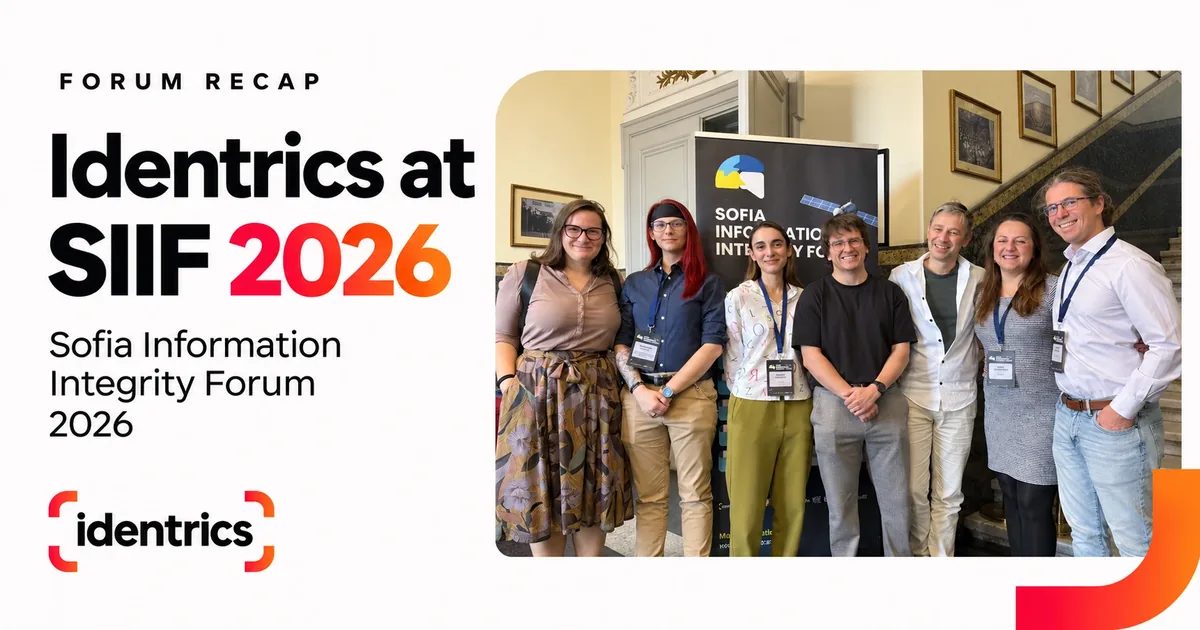
Photos From SIIF 2026
Five Years of the Forum
Some things are worth showing up for every single year. For us, this forum is one of them. In 2022, we helped start a small conference called Technologies Against Disinformation, together with GATE Institute and fellow Bulgarian technology companies. It grew into the Sofia Information Integrity Forum. Formats changed, the name changed and the circle of organisers widened. We have been there for every edition.
Every Edition at a Glance
| Year | Edition | Dates and venue | Identrics on the programme |
|---|---|---|---|
| 2026 | SIIF 2026 | 11-13 November, Central Military Club | Nesin Veli at the opening; Todor Kiriakov presenting; Devora Kotseva moderating two panels |
| 2025 | SIIF 2025 | 5-7 November, GATE Institute, Sofia University | Nesin Veli presenting; Todor Kiriakov and Devora Kotseva moderating; Dr Yolina Petrova on a panel; Todor Kiriakov moderating a CoDE session |
| 2024 | SIIF 2024 | 7-9 November, Central Military Club | Nesin Veli presenting; Yolina Petrova co-moderating |
| 2023 | Technologies Against Disinformation 2.0 | 2023 | Vasil Shivachev, then COO, presenting |
| 2022 | Technologies Against Disinformation | July 2022 | Vasil Shivachev, then COO, presenting |
Technologies Against Disinformation (2022)
In July 2022, Identrics organised the first Technologies Against Disinformation conference with Ontotext, Sensika Technologies and GATE Institute. It ran two panels: a technological one moderated by Milena Dobreva, Associate Professor at GATE Institute, and a practical one moderated by journalist Mirolyuba Benatova. Bozhidar Bozhanov, then Minister of e-Government, opened the conference.
Our then COO, Vasil Shivachev, spoke on using technology against disinformation. He presented our online news quantifier, which clusters content to show emerging topic trends, and named three parts of ethical AI: regulation, model explainability and a human in the loop.
From Problems to Solutions (2023)
The second edition aimed to move from naming problems to proposing solutions, with the same four organisers. Speakers included Todor Tagarev, then Minister of Defence, and Bozhidar Bozhanov, then Chairman of the e-Government and Information Technology Committee in the Bulgarian Parliament. Vasil Shivachev spoke on turning information into actionable knowledge: "We should aim to build an ecosystem, rather than working solo on potential cures." Our recap of that edition announced what came next: the Sofia Information Integrity Forum.
SIIF 2024: The First Forum Under the New Name
SIIF 2024 ran from 7 to 9 November at the Central Military Club in Sofia. It was organised by the Human and Social Studies Foundation - Sofia (HSSF), the Center for the Study of Democracy, GATE Institute, Identrics, Ontotext, Sensika and CoDE. Speakers included Mark Galeotti, Susanne Spahn, Andy Carvin of the Atlantic Council's DFRLab, Marius Dragomir, Dr Neville Bolt and Miroslav Sazdovski of Hybrid CoE.
Getting Ahead of Hindsight
On the first day, our CEO, Nesin Veli, presented "Information Disorder: Getting Ahead of Hindsight".
AI and the Information Space
On the second day, Yolina Petrova co-moderated "Artificial Intelligence and Understanding the Shifting (Dis)Information Landscape" with Todor Kiriakov, then of A Data Pro.
SIIF 2025: Three Days, Two Halls
From 5 to 7 November 2025, GATE Institute at Sofia University "St. Kliment Ohridski" hosted the forum, with sessions streamed on Discord. The organisers were the Center for the Study of Democracy, HSSF, GATE Institute, Identrics, Sensika and Graphwise. Over 500 participants took part across two parallel halls. Atanas Zapryanov, Minister of Defence, opened the forum, and Stephan Lewandowsky of the University of Bristol gave the opening keynote.
Frontier Technology
On the first afternoon, our Information Integrity Specialists, Todor Kiriakov and Devora Kotseva, moderated "Faster >> Better >> Stronger: Defending and Reinforcing Information Integrity with Frontier Technology".
From Reaction to Strategy
Later that day, Nesin Veli presented "From Reaction to Strategy: How Predictive Models Are Streamlined into Prediction Systems for Simulation Exercises".
"We are excellent at reacting, but terrible at predicting."
Influence and Cognition
On the final morning, Dr Yolina Petrova, our Chief Operations & AI Officer, joined "Influence Through Information: What happens in your body, and beyond" with Andy Stoycheff and Assoc. Prof. Dr Ralitsa Kovacheva of NTCenter. Later that morning, Todor Kiriakov moderated the session on CoDE and the DisInfoHack "slow" hackathon model, with teams from DisInfoHack 2025.
Read our SIIF 2025 recap.
Why We Keep Showing Up
Why stay? Because technology alone is not always the answer. No single tool, policy or training fixes information integrity. That was our clearest lesson from SIIF 2025, and it is why Identrics needs to be in the same room as the researchers, policymakers, journalists and civil society who see what our systems cannot.
We are grateful to everyone who has built this forum with us since 2022, and to our co-organisers.
About the author
Identrics Editorial Team
Editorial team, Identrics
Reporting by the Identrics editorial team - covering company news, partnerships, conferences, and joint research.