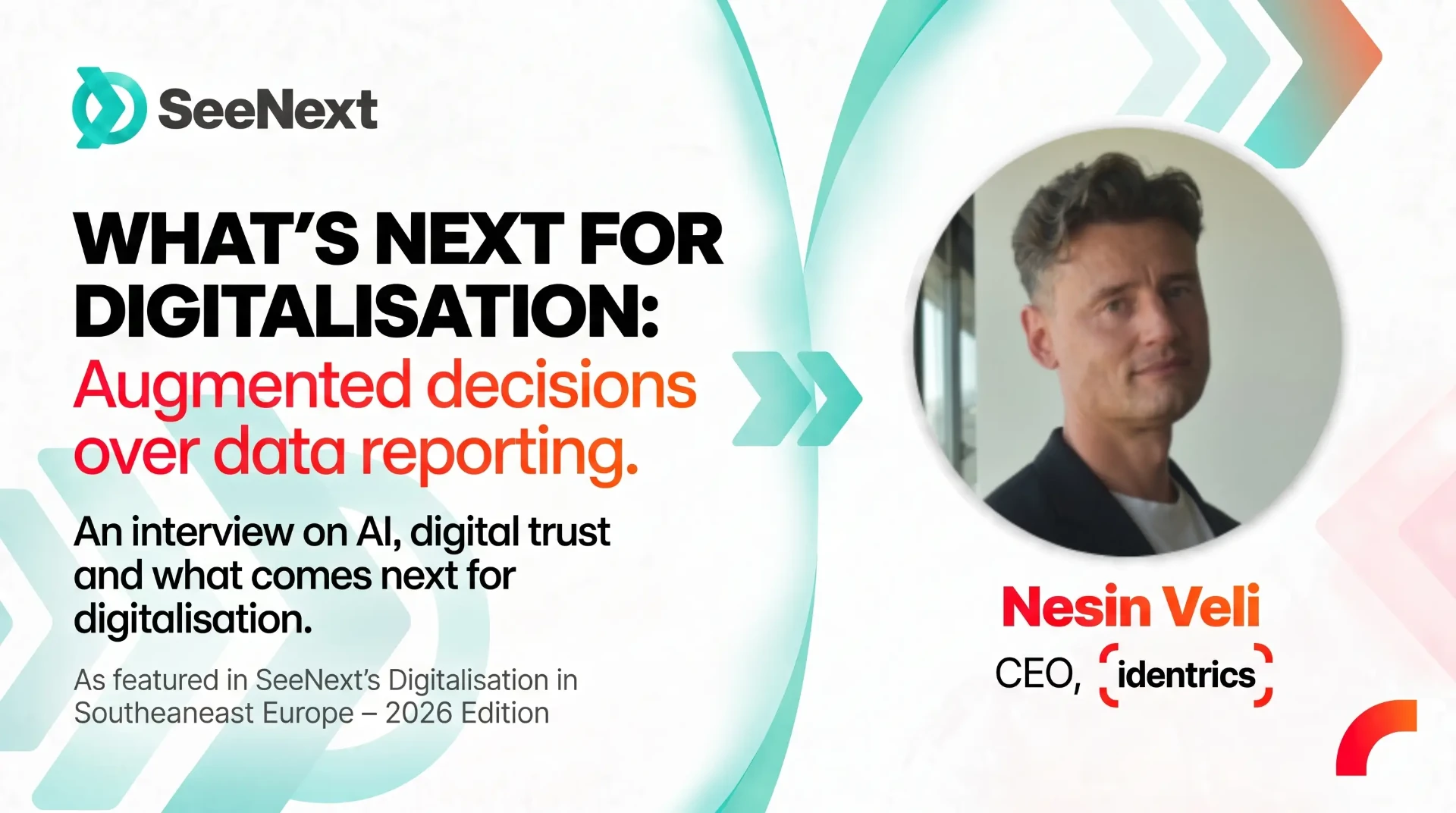
Nesin Veli, CEO of Identrics, recently did an interview with SeeNext on AI-driven digitalisation, the changing value of information, digital trust, and why Pingrid treats media intelligence as a living graph.
Originally published in SeeNext’s Digitalisation in Southeast Europe.
We often talk about digital transformation as productivity, automation and efficiency. In this interview with SeeNext, Nesin Veli argues that the next stage is different: augmented decisions, continuously updated intelligence, and trust that still sits with people.
We often talk about digital transformation in terms of productivity, automation and efficiency. Do you think anything is missing from that conversation?
AI and LLMs in particular have been the most impactful automation drivers in the way of public awareness. As this technology is maturing into its observable and practical capabilities, the workflow digitalisation for purely time efficiency gains is moving into actual workflow transformation and expansion of operational intelligence, and to some extent consumer-facing capabilities.
For the last decade digital transformation was largely an exercise in digitising legacy operations, moving workloads to the cloud, eliminating physical friction points, applying rule-based automation, and overall driving the cost down of existing processes. These are very much still a target for a myriad of companies yet to make the first jump towards digitalisation. For the rest, the next and necessary step to stay competitive is going from process automation to autonomous processes.
Even before the frontier, we now have access to AI models with sufficient agentic capabilities which can be reined in into predictable pipelines by correctly integrating them into a harness of company data and rule-based checks. This allows for much more flexibility around augmenting digital processes and even creating new ones and has the potential to move from back-office cost reduction to consumer value creation.
If digitalisation is moving beyond technology adoption and infrastructure, and towards changing how people work and access services, how would you describe the main characteristics of this stage?
Augmented decisions over data reporting. Rather than relying on a static snapshot dashboard, decision-makers can interact with adaptive and context-aware systems that provide real-time scenario modeling and prescriptive insights. Judgment remains human, but the heavy cognitive workload of data synthesis is shared with intelligent systems.
Hyper-personalisation, but for good. Instead of destroying what little remains of monoculture and water cooler talks, customer and citizen service models can move away from reactive portals, forms, and apps toward proactive, natural-language interactions. Systems can anticipate user intent based on context and deliver personalized outcomes with less administrative friction.
Democratised, albeit superficial technical capability. Slop code does not have a place in the engineering vertical, from production to the intern’s output. But once you step horizontally, towards executives and managers, natural language interfaces and low-code environments can enhance the communication gap by building quick demos, proof of concepts, and feature requests and facilitate a swifter and richer internal operational communication.
How is the value of information changing as AI makes it possible not only to collect data, but to continuously connect, interpret and update it?
When data was more difficult to collect and store, value resided in scarcity and scale, which resulted in data lakes and repositories, which now have a new role to play. As AI continuously connects, interprets, and generates streams of information, the value shifts towards proof of truth, context and recency.
As the media landscape chases after the changing consumer patterns, static information quickly loses value. A contact database, for example, could tell you who someone was or what they did several months ago, but that may no longer reflect their current role, interests or areas of expertise.
AI, in all of its current forms, is making it possible to move from static information towards continuously updated intelligence. Systems can identify relationships, detect changes, interpret context and bring together information from different sources. This means the value of information increasingly depends on whether it is relevant to your current and specific need.
At the same time, this makes trust even more important. If AI is continuously interpreting and updating information, we need to understand and know where that information comes from and how confident we can be in it. So, those data lakes and repositories are now the basis layer of interpretability and traceability upon which the autonomous analysis is built.
The more digital our lives and services become, the more we ask people to trust the systems behind them. What does it take to build genuine digital trust?
Security and privacy are obviously fundamental and people need to know how their data is protected, how it is not exposed unnecessarily. As AI becomes more involved in decisions and information flows, trust also depends on transparency, reliability and accountability.
An important principle is having the opportunity and mechanism to try and understand the origin and quality of the information behind a digital solution. If an AI system provides an answer or recommendation, we should increasingly be able to trace where this information comes from, how current it is, how confident we are that it is correct and who is accountable if it is wrong.
Ultimately trust is a currency which is exchanged between parties who can hold it and today and for the foreseeable future I am not seeing this moving away from the hands of people, be it as guarantors of services rendered or bearers of responsibility when the quality of these services is challenged.
You have launched Pingrid, a system that continuously discovers and connects information about journalists, media outlets and influencers. What problem were you trying to solve with it?
Information about professionals, organisations and their relationships has always been dynamic, while the systems that tried to manage that information remained largely static, and now we have the added complication of low-quality content injected at scale into the communication sphere. So, we set out to make it easy to connect the people with important messages to the people with the skills to deliver them.
In light of the redrawn borders of the media landscape between traditional, independent, social, audio, clips, and newsletter mediums, we wanted to create the means to understand these ongoing dynamics. And while the driving forces behind them are often unknowable enterprise algorithms, the patterns of these dynamics are traceable by the narrative flow between the actors in the conversations.
We aim to facilitate the creation of more organic communication and narratives by making it very easy for your communication teams to reach the author and journalist writing on your relevant beats, the spokesperson on behalf of the company you are interested in and the different kinds of content creators which can facilitate your narrative, all of it based on real-time contextual information.
The overall idea is that we should no longer treat information as a sequence of static databases. With relationships between people, organisations, narratives and audiences constantly changing, our systems need to reflect that dynamics.
Nesin Veli is CEO of Identrics, an applied AI company curating and creating knowledge for Governance, Risk & Compliance providers and media intelligence organisations. Building on its work in media intelligence, Identrics launched Pingrid, a real-time research API that brings up-to-date journalist, creator and influencer intelligence into PR and communications platforms.
About the author
Identrics Editorial Team
Editorial team, Identrics
Reporting by the Identrics editorial team - covering company news, partnerships, conferences, and joint research.